drawing dots in 3d html5
past lars verspohl
D3 and Sheet in 3 steps
The bind, the draw and the interactivity
Allow'south say you're building a data visualization using D3 and SVG. You may hit a ceiling when you endeavor to display several thousand elements at the same time. Your browser may start to puff under the weight of all those DOM elements.
Well here comes HTML5 Canvas to the rescue! It'southward much faster, then information technology can solve your browser's puffing problems.
But you may rapidly find yourself daunted. Because D3 and Canvas works a chip differently from D3 and SVG — particularly when it comes to drawing and adding interactivity.
Simply fear not — it's not that complicated. Whatever feel you've had with building visuals with D3 and SVG — or approaching D3 with a different renderer — will aid yous tremendously.
This tutorial built on the shoulders of giants who have already covered Canvas well. I learned these three tutorials past centre and I recommend you practice, too:
- Working with D3.js and Sail: When and How from Irene Ros
- Needles, Haystacks, and the Canvas API from Yannick Assogba
- Learnings from a D3.js addict on starting with Canvass from Nadieh Bremer
So why proceed reading this, and so? Well, when I desire to learn something new, information technology helps me a dandy deal to look at the aforementioned subject from slightly unlike angles. And this tutorial is a slightly unlike angle.
Also, this tutorial covers the three key steps: bounden data, drawing elements, and adding interactivity — and it does all this in i go, with an added step-past-pace transmission to set you up.
What exercise we build?
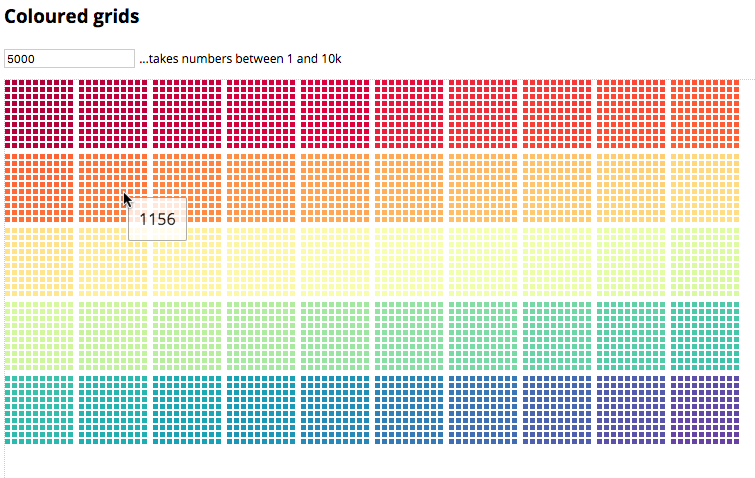
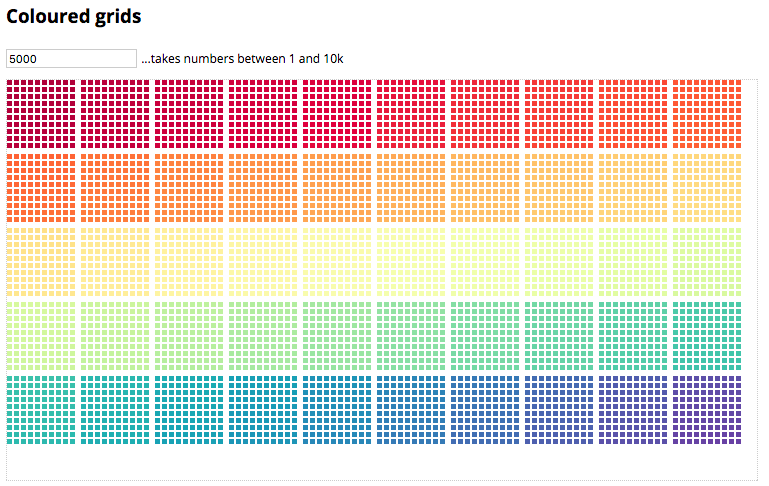
A grid of (many) squares. Their colours aren't of whatsoever deep meaning but don't they look pretty? The important bit is that you can update it (to embrace binding and updating information), that it has many elements (upward to 10,000 in society for canvas to pay out), and that you can hover over each square to show foursquare-specific information (interactivity). Yous can play with it here on a full screen or hither with all the code
The mental model
Before nosotros really dive in, let's apace footstep dorsum and grasp conceptually what nosotros practise when we create elements with D3 to depict them to the screen. Skip this if yous but desire to make things.
The start stride when using D3 unremarkably doesn't involve drawing — it involves preparing all your elements y'all want to depict. Information technology'due south a bit like building some LEGO. Y'all can rip open the box and beginning building something or you tin look at the manual first and build it according to the pattern. The manual is your mental model, a blueprint or recipe of what you desire to build.
What is D3's model? Autonomously from the large number of helpful functions and methods that calculate positions, re-shape datasets (the layouts) and generate functions that draw, for example, paths for us, D3 has a model for how the elements' lives should evolve on the screen. It has a certain fashion to think virtually the lifecycle of each element.
Less ethereally, you inject data into a all the same non-real DOM, and D3 creates new elements of your choice as per the data you inject. Commonly ane chemical element per datapoint. If you lot desire to inject new data into the DOM yous can do and so and D3 identifies which elements have to be newly created, which elements are allowed to stay and which elements should pack up and leave the screen.
D3 is usually used in conjunction with SVG or sometimes with HTML-elements. In this orthodox case, y'all can come across the data in the DOM when yous choose to await at it through the console, for instance. Y'all can grab it, you tin can move information technology up or down the DOM and you lot can — importantly — add interactivity to each element you similar to show, for example, a tooltip.
But — on the downside — you can't prove a lot of elements. Why? Because the more elements you push into the DOM, the harder the browser has to work to brandish them all. Permit them as well move effectually and the browser needs to re-calculate them constantly. The more knackered the browser gets the lower your frame rate or FPS (Frames Per Second), which measures how many frames the browser tin can paint each second. A frame charge per unit of 60 is expert and enables a fluid experience every bit long every bit no frames are missed — a frame rate of anything nether thirty tin can equal a choppy ride. So when you lot want to testify more elements, you can revert to canvas.
Why canvas? Canvas is an HTML5 element which comes with its own API to paint on it. All elements drawn on the canvas element won't manifest in the DOM and save a lot of work for the browser. They are drawn in immediate style. This means the rendered elements won't get saved in the DOM but your instructions describe them directly to a particular frame. The DOM only knows the one sail element; everything on it is only in memory. If y'all want to modify your canvas elements you have to redraw the scene for the next frame.
The problem with this is of form that you can't communicate directly with these non-material elements living in memory. You have to find a mode to talk to them indirectly. This is where the D3 model comes in as well as custom or 'virtual' DOM-elements. What you'll exercise in principal is:
- Bind your data to custom DOM elements. They don't live in the DOM just only in memory (in a 'virtual' DOM) and describe the life-cycle of these elements in a known D3 way.
- Employ canvass to describe these elements.
- Add interactivity with a technique chosen 'picking'.
Let's practice information technology.
The data
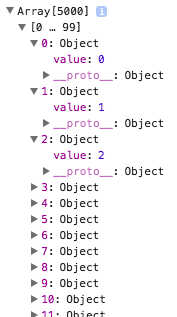
Before we start to code, allow's produce some data. Let'south say y'all want five,000 datapoints. So let's create an array with 5,000 elements, each of which is an object with just a single property value conveying the element'south index. Hither's how you create it with d3.range(). d3.range() is a D3 utility function, that creates an assortment based on its argument:
var data = []; d3.range(5000).forEach(role(el) { data.push({ value: el }); }); Here's how the information looks in the panel
Thrills!
The sheet container and its tools
The sheet element is an HTML element. It's conceptually very much similar any SVG-parent-element, which I at to the lowest degree usually add to a simple container div equally in:
<div id="container"></div> And so, permit'southward add it to your container with D3 equally in…
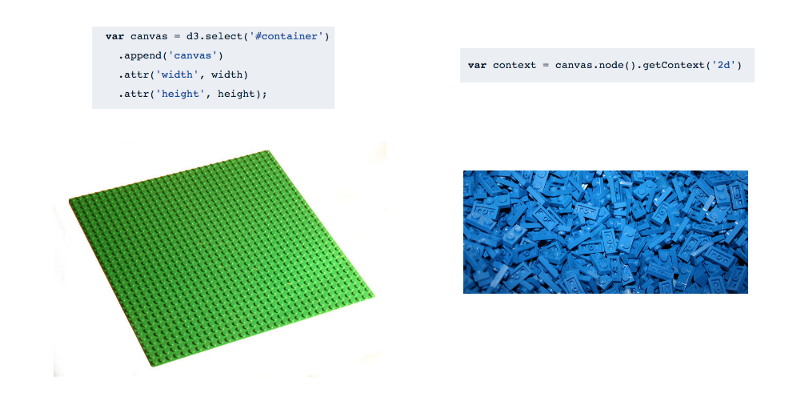
var width = 750, height = 400; var sail = d3.select('#container') .append('sheet') .attr('width', width) .attr('acme', meridian); var context = sheet.node().getContext('2d'); You also need to add the context, which is the canvass toolbox. The context variable is from at present on the object carrying all the properties and methods, the brushes and colours you demand to depict on the canvas. Without the context, the canvas chemical element would remain empty and white. That's all you need to setup — a canvas and its tools…
The HTML
…is elementary. The main HTML structure of your site will be:
<!-- A championship --><h3>Coloured grids</h3> <!-- An input field with a default value. --> <input type="text" id="text-input" value="5000"> <!-- An caption... --> <div id="text-explain">...takes numbers between ane and 10k</div> <!-- ...and a container for the sheet chemical element. --> <div id="container"></div> The Javascript construction
On a top level yous only need 2 functions:
databind(data) { // Bind information to custom elements. } describe() { // Depict the elements on the canvas. } Pretty straight frontward then far.
Bind the elements
To bind data to the elements y'all first create a base of operations element for all your custom elements y'all volition produce and draw. If you know D3 well, retrieve of it as a replacement to the SVG element:
var customBase = certificate.createElement('custom'); var custom = d3.select(customBase); // This is your SVG replacement and the parent of all other elements And then you add some settings for your grid. In brusque, these settings permit y'all to draw a filigree of squares. 100 squares build a 'package' and at that place is a line break after 10 parcels (or after one,000 squares). You lot tin conform this for different 'parceling' of the squares or different line-breaking. Or just not worry almost information technology. I advise the latter…
// Settings for a filigree with 10 cells in a row, // 100 cells in a cake and grand cells in a row. var groupSpacing = 4; var cellSpacing = 2; var offsetTop = height / five; var cellSize = Math.floor((width - 11 * groupSpacing) / 100) - cellSpacing; Now let's offset the data-binding mission. Let's become the necessities out of the style first and create a colour scale you lot will utilise to your squares a little subsequently.
function databind(data) { // Get a scale for the colours - not essential but nice. colourScale = d3.scaleSequential(d3.interpolateSpectral) .domain(d3.extent(data, part(d) { return d; })); Now let's join your data to the 'replacement-SVG' you chosen custom to a higher place and add yet not-existing custom elements with the class .rect
var join = custom.selectAll('custom.rect') .information(data); Yous enter the custom elements (remember goose egg enters the DOM, this is all in retentiveness).
var enterSel = join.enter() .suspend('custom') .attr('grade', 'rect') .attr("x", function(d, i) { var x0 = Math.floor(i / 100) % x, x1 = Math.floor(i % 10); return groupSpacing * x0 + (cellSpacing + cellSize) * (x1 + x0 * 10); }) .attr("y", function(d, i) { var y0 = Math.flooring(i / 1000), y1 = Math.floor(i % 100 / 10); render groupSpacing * y0 + (cellSpacing + cellSize) * (y1 + y0 * 10); }) .attr('width', 0) .attr('height', 0); When an element enters your model, you just give information technology an x and a y position too as a width and a height of 0, which you'll modify in the upcoming update choice…
Y'all merge the enter selection into the update pick and ascertain all attributes for the update and enter choice. This includes a width and a acme value as well every bit a color from the colour calibration you built earlier:
join .merge(enterSel) .transition() .attr('width', cellSize) .attr('top', cellSize) .attr('fillStyle', function(d) { render colourScale(d); }); Two things of note near this last line. When you work with SVG this line would be
.style('color', function(d) { render colourScale(d); }) But with sail yous use .attr(). Why? Your main involvement here is to detect a pain-free way to transfer some element-specific information. Hither you lot want to transfer a color-string from the databind() to the describe() function. You use the element simply as a vessel to transport your data over to where it is being rendered to the canvas.
That'southward a very important distinction: when working with SVG or HTML you can bind data to elements and depict or employ styles to the elements in one step. In canvas you need two steps. Commencement you bind the data then you draw the information. Y'all can't style the elements while binding. They only exist in memory and sail can't exist styled via CSS way properties, which is exactly what you access when using .mode().
At first, this might seem limiting as y'all tin do less in one step, but it'due south conceptually almost cleaner and also gives you some freedom. .attr() allows us to send whatever key-value pairs on the journeying. You could apply other methods like the HTML .dataset property for example, but .attr() volition do just fine.
Notice we don't say color merely fillStyle. To exist honest, you lot could use colour or you could use chooChooTrain here. You would just need to remember this when y'all fetch the information later on during cartoon. Notwithstanding, every bit sail uses a property called fillStyle to manner elements, it seems more appropriate in this instance.
Finally, you also ascertain the leave pick, deciding what should happen to exiting elements.
var exitSel = join.exit() .transition() .attr('width', 0) .attr('top', 0) .remove(); That's it! You can close your databind() office and motility on...
} // databind() This is non really scary coming from D3 as it's pretty much exactly the same. You lot take now successfully created your data model, the way the awarding will think about information. Each element will get the backdrop information technology needs to be drawn via the .attr() functions and each element will be assigned a life-cycle state depending on the injected data. Our standard D3 model.
Drawing the elements
Now you demand to write the depict function to go the elements on screen. Let's just notation here that cypher has happened yet. You haven't chosen databind() all the same because you need to find a way to describe it to the sheet offset. So here we go... The depict() office doesn't need to have any arguments in this case:
function depict() { As mentioned fleetingly above, you need to take care of cleaning the sheet every time you lot draw afresh. The DOM is cloth, in that when you draw a rect-element on it and y'all modify its x value, it volition move in the x-management and the DOM will accept care of this move (or the re-pigment) automatically.
If you lot motility a rect from x = 0 to ten = 1 at a certain signal in time (later a push button press for example) the browser will move the rect from 0 to 1 within one tick or frame-paint (which is roughly 16ms long). If y'all motility it from 0 to 10, information technology will do and then in a time depending on the duration you asked this transition to happen, perchance one pixel per tick maybe 8 pixel per tick (for more than read this web log post).
But it will tell the pixel at 0 that the rect has disappeared and the pixel at 1 that in that location is a rect at present. Canvas doesn't practise this. You demand to tell canvas what to paint, and if yous paint something new, you lot need to tell information technology to remove the previous paint.
So let's start with cleaning up anything that might exist on the canvas before you draw. Here'southward how:
context.clearRect(0, 0, width, height); // Clear the canvass. Simple.
At present you lot…
- …get hold of all elements in order to
- loop through all elements and
- take the information yous have stored in the
databind()function to draw the element:
// Draw each private custom element with their backdrop. var elements = custom.selectAll('custom.rect');// Take hold of all elements you bound data to in the databind() role. elements.each(role(d,i) { // For each virtual/custom chemical element... var node = d3.select(this); // This is each individual element in the loop. context.fillStyle = node.attr('fillStyle'); // Here you recall the colour from the private in-memory node and set the fillStyle for the canvas paint context.fillRect(node.attr('10'), node.attr('y'), node.attr('width'), node.attr('pinnacle')); // Here you retrieve the position of the node and utilize it to the fillRect context role which will fill and paint the foursquare. }); // Loop through each chemical element. And that'southward it! You can close the describe() function
} // draw() When I started with canvas subsequently a while of wanting to swoop into it, this simplicity really upped my spirits.
However, nothing has happened in the browser notwithstanding. We take the tools in the databind() and the depict() role, but goose egg has been drawn notwithstanding. How do you exercise this? If you just wanted to draw a static visual or image, y'all just telephone call:
databind(data); depict(); This would demark the data to the custom elements, which would live in memory and then depict it — once!
But you have transitions. Remember above: when yous wrote the databind() function you transitioned the jail cell width and height from 0 to their size equally well as the colour from black (the default) to the respective element's color. A default D3 transition lasts 250 milliseconds, and then yous need to redraw the squares many times in these 250 ms in society to get a smooth transition. How practise you do this?
It's again elementary. You simply telephone call databind(information) to create our custom elements before you repeatedly call draw() for every bit long as it takes the transition to run. And then in our case at least 250 ms. You could use setInterval() for this only we actually should use requestAnimationFrame() in social club to be every bit performant as possible (for more read this). In that location are a few means to employ it, but keeping within the D3 spirit, I suggest using d3.timer() which implements requestAnimationFrame() as well as being straight forrard to use. So here we become:
// === First call === // databind(d3.range(value)); // Build the custom elements in memory. var t = d3.timer(function(elapsed) { depict(); if (elapsed > 300) t.stop(); }); // Timer running the draw function repeatedly for 300 ms. d3.timer() calls the callback repeatedly until elapsed (which is the passed time in milliseconds from instantiation) is past 300 so the timer is stopped. In these 300 milliseconds, it runs the draw() at each tick (roughly each 16ms). describe() then looks at each chemical element'south attributes and draws them appropriately.
This is how a transition works in canvas. You telephone call the drawing office correct subsequently the binding part many times. Whatsoever your D3-model is fix to transition (positions, colours, sizes) will exist re-fatigued many times with small incremental changes for each draw
Note that describe() needs to come right after the databind() part. You couldn't inquire the auto to run databind(), and so do something else for a second and then call describe(). Because after one second the transitioned states calculated by your databind() function have all transitioned already. Done, dusted and forgotten.
That'south it! You've leap information to custom elements and you've drawn it to the sail.
Let the user update the number of squares
To give the user the hazard to echo this feat with a custom number of elements (ok, semi-custom with a maximum of x,000) y'all add the following listener and handler to your text-input box:
// === Listeners/handlers === // d3.select('#text-input').on('keydown', function() { if (d3.upshot.keyCode === xiii) { // Only exercise something if the user hits return (keycode 13). if (+this.value < 1 || +this.value > 10000) { // If the user goes lower than 1 or college than 10k... d3.select('#text-explain').classed('alarm', truthful); // ... highlight the note nigh the range and return. return; } else { // If the user types in a sensible number... d3.select('#text-explain').classed('warning', false); // ...remove potential alert colours from the note... value = +this.value; // ...gear up the value... databind(d3.range(value)); // ...and bind the data. var t = d3.timer(function(elapsed) { draw(); if (elapsed > 300) t.finish(); }); // Timer running the draw function repeatedly for 300 ms. } // If user hits return. }); // Text input listener/handler Here information technology is once more, our colourful grid of canvas squares, ready to be updated and redrawn:

Interactivity
The biggest 'hurting' with canvas in comparing to SVG or HTML is that there are no material elements living in the DOM. If there were you could simply annals listeners to the elements and add handlers to the listeners. For example you tin trigger a mouse-over on an SVG rect chemical element and whenever the listener triggers, you could do something to the rect. Like showing information values stored with the rect in a tooltip.
With canvass you have to find another way to make an event heard on our canvas elements. Luckily there are a number of clever people who thought of an indirect merely logical way.
And so what interactivity exercise we want? As said above permit's go for a tooltip and let'due south assume you desire to show the index of the foursquare in a tooltip as soon equally you hover over the element. Not very thrilling, simply the primal is that you can access the data bound to the chemical element by hovering over it.
Picking
At that place are a few steps involved (all logical though). But in brusk you will build two canvases to accomplish this. One main canvas that produces our visual and one hidden canvas (equally in we can't run across it) that produces the same visual. The key hither is that all elements on the second canvas will be at the exact same position in relation to the canvas origin compared to the beginning sheet. So square 1 starts on 0,0 on the primary canvas as well every bit on the subconscious canvas. Foursquare ii starts on 8,0 on the main canvas every bit well as on the hidden canvas and and so on.
In that location is merely i important difference. Each element on the hidden canvas will become a unique colour. Nosotros will create an object (or rather an associative assortment or map for brevity) that links each unique colour to each element's data.
Why? Because next we attach a mouse-motility listener to the main-canvas to retrieve a stream of mouse-positions. At each mouse-position we can use a sail-own method to "pick" the color at this exact position. Then nosotros just look up the color in our associative assortment and we accept the data ! And nosotros're flying…

You could say "well, my squares take already got a unique colour, I can use those?" And indeed, you could utilize them. Nevertheless, your interactivity would go out of the window as before long every bit y'all decide to insufficient your squares from the colours. So y'all should brand sure to e'er have one sail — the subconscious canvas — that has a guaranteed set of unique colours for the squares.
Permit's employ this technique pace by step. The code you've built so far can stay as it is — you merely add together to it equally y'all go forth.
one. Set up the hidden sheet
Offset let'southward create the subconscious canvas that will harbour our visual with a unique colour per square.
1.1 Create hidden sheet chemical element and prepare its CSS to { display: none; }.
// Rename the chief canvas and add together a 'mainCanvas' form to it. var mainCanvas = d3.select('#container') .append('canvas') .classed('mainCanvas', truthful) .attr('width', width) .attr('elevation', height); // new ----------------------------------- // Add the subconscious canvas and requite it the 'hiddenCanvas' class. var hiddenCanvas = d3.select('#container') .append('canvas') .classed('hiddenCanvas', truthful) .attr('width', width) .attr('height', summit); In fact, I won't prepare the canvas to hidden in this case to show what is going on. But to do so, but add together .hiddenCanvas { display: none; } to your CSS and the act is washed.
1.2 Build the context variable in the draw() part and pass 2 arguments to the role: the canvas also every bit a boolean called 'hidden' determining which sheet nosotros build (hidden = true || fake) as in:
role depict(canvass, subconscious) { 1.3 You at present need to adapt all draw functions to include the two new draw() arguments. So from now on, y'all don't just call draw() y'all call either draw(mainCanvas, false) or describe(hiddenCanvas, true)
2. Employ unique colours to the subconscious elements and map them
Hither, dear reader, comes the fundamental part of our operation, the engine of our truck, the spice in our soup.
2.1 Include a function to generate a new unique color every time it gets chosen (via Stack Overflow)
// Function to create new colours for the picking. var nextCol = 1; function genColor(){ var ret = []; if(nextCol < 16777215){ ret.push(nextCol & 0xff); // R ret.push((nextCol & 0xff00) >> 8); // G ret.push((nextCol & 0xff0000) >;> 16); // B nextCol += 1; } var col = "rgb(" + ret.join(',') + ")"; render col; } genColour() produces a color defining string in the grade rgb(0,0,0). Every fourth dimension it's called it increments the R value by 1. Once it reaches 255, information technology increments the Thou value by 1 and resets the R value to 0. Once it reaches r(255,255,0) it increments the B value past 1 resetting the R and the 1000 to 0 then on.
Then in full you can have 256*256*256 = xvi.777.216 elements to retain a unique colour. However, I can assure you your browser volition die beforehand. Fifty-fifty with canvass (webGL tutorial to follow).
2.two Create the map-object that will keep track of which custom element has which unique color:
var colourToNode = {}; // Map to track the color of nodes. You lot tin add together the genColour() part wherever you desire in your script, as long as it's outside the databind() and draw() part telescopic. But annotation that your map variable needs to exist created before and beyond the scope of the databind() role.
2.3 Add together a a unique colour to each custom element equally for example .attr('fillStyleHidden') and
2.4 build the map-object during element creation
Here yous'll use your 'colour-canon' genColour() in our databind() function when assigning the fillStyle to our elements. Every bit y'all likewise have access to each datapoint while it's being spring to each element, you lot can bring colour and information together in your colourToNode map.
bring together .merge(enterSel) .transition() .attr('width', cellSize) .attr('height', cellSize) .attr('fillStyle', function(d) { return colorScale(d.value); }); // new ----------------------------------------------------- .attr('fillStyleHidden', role(d) { if (!d.hiddenCol) { d.hiddenCol = genColor(); colourToNode[d.hiddenCol] = d; } // Here you (i) add together a unique colour every bit property to each element // and(two) map the colour to the node in the colourToNode-map. return d.hiddenCol; }); 2.5 You lot can now color the elements according to the canvas the draw() function is rendering. You add a conditional on the fillStyle in the draw() function applying the colours for our visual to the main canvass and the unique colours to the hidden sail. It'south a simple one-liner:
context.fillStyle = hidden ? node.attr('fillStyleHidden') : node.attr('fillStyle'); // The node colour depends on the sheet you draw. The primary canvas yet looks the same of course:
Let's finally add together some interactivity and get-go with drawing the subconscious canvas whenever we motility the mouse onto our main canvas.
3. Pick up the colours with the mouse
3.i Starting time, simply register a listener to the main canvas, listening to mouse-move events.
d3.select('.mainCanvas').on('mousemove', function() { }); Why mousemove? As you can't register listeners with private squares just have to employ the entire canvas yous won't be able to work with mouseover or -out events as they volition only trigger when inbound the sheet not the elements. In order to get the mouse position on your sail y'all can do mousemove or click/mousedown.
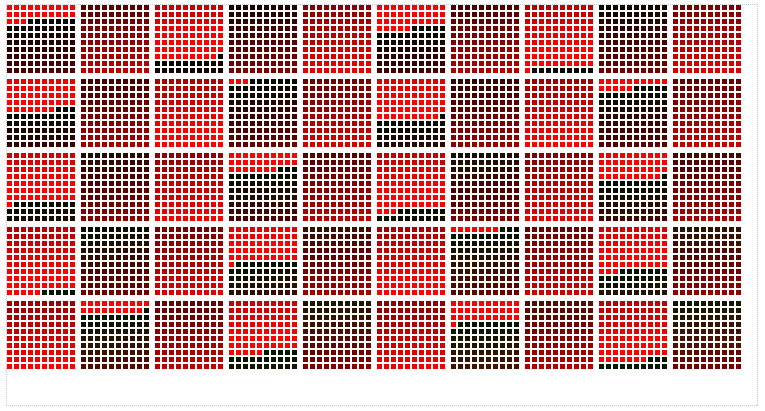
d3.select('.mainCanvas').on('mousemove', function() { draw(hiddenCanvas, true); // Depict the subconscious canvas. }); This way, the first thing our user triggers when mousing over the principal canvass is to unknowingly create the hidden canvas. As said, in production this canvas would be hidden, but for our educational purposes we desire to come across information technology and indeed, trigger the hidden sheet to exist drawn when the mouse moves over the primary sail like and so:
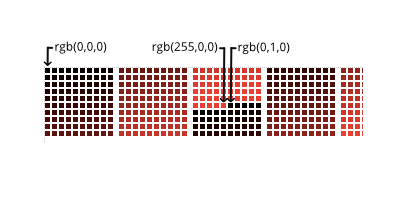
The colours on the principal canvas range from black to carmine, from rgb(0,0,0) to rgb(255,0,0) and and then it looks as if the aforementioned range from black to reddish is repeated. However, at present the colour ranges from a slightly greener blackness, precisely from rgb(0,1,0) to rgb(255,one,0):
Zooming into the kickoff couple of hundred squares, here are the colours of the first, the 256th and the 257th foursquare:
3.3 As our hidden canvas is structurally a carbon re-create of our main sail, all the subconscious canvas elements will exist at the same position equally the elements on our main canvas. So, y'all can now use the mouse's x and y positions y'all are collecting from the listener on the main sheet to constitute the aforementioned location on the hidden canvas. Dorsum in the listener, you add:
d3.select('.mainCanvas').on('mousemove', function() { // Depict the hidden canvas. describe(hiddenCanvas, truthful); // Become mouse positions from the main canvas. var mouseX = d3.event.layerX || d3.consequence.offsetX; var mouseY = d3.issue.layerY || d3.event.offsetY; }); Note here we have the consequence.layerX and outcome.layerY properties which return the mouse position including scrolling. This can break then use offsetX every bit a fallback (or just apply offsetX).
three.4 The picking: Canvas greatly allows admission to the pixel-data the mouse is hovering over with the getImageData() function and its .data belongings. In full bloom this will look similar:
getImageData(posX, posY, 1, 1).data .
It volition return an array with four numbers: the R, the G, the B and the alpha value. As you diligently built the colourToNode map assigning the element data to each of its subconscious colours, you can now access this chemical element's data only by looking up the colour in the map!
d3.select('.mainCanvas').on('mousemove', function() { // Draw the subconscious canvass. draw(hiddenCanvas, true); // Get mouse positions from the principal sheet. var mouseX = d3.event.layerX || d3.event.offsetX; var mouseY = d3.issue.layerY || d3.event.offsetY; // new ----------------------------------------------- // Get the toolbox for the hidden canvas. var hiddenCtx = hiddenCanvas.node().getContext('2d'); // Pick the colour from the mouse position. var col = hiddenCtx.getImageData(mouseX, mouseY, i, one).information; // Then stringify the values in a style our map-object tin read information technology. var colKey = 'rgb(' + col[0] + ',' + col[1] + ',' + col[two] + ')'; // Get the information from our map! var nodeData = colourToNode[colKey]; console.log(nodeData); }); And indeed, logging the nodeData to the panel returns an object every time you hover over a square:
The data per node now shows the value which constitutes the original data as well as the key hiddenCol showing this node's colour for the subconscious canvas:

3.5 Finally — and that's a formality — you add the tooltip
d3.select('.mainCanvas').on('mousemove', function() { // Draw the hidden sail. describe(hiddenCanvas, true); // Go mouse positions from the primary canvas. var mouseX = d3.event.layerX || d3.event.offsetX; var mouseY = d3.event.layerY || d3.effect.offsetY; // Become the toolbox for the hidden canvas. var hiddenCtx = hiddenCanvas.node().getContext('second'); // Selection the color from the mouse position. var col = hiddenCtx.getImageData(mouseX, mouseY, ane, 1).information; // Then stringify the values in a way our map-object can read information technology. var colKey = 'rgb(' + col[0] + ',' + col[1] + ',' + col[2] + ')'; // Get the data from our map! var nodeData = colourToNode[colKey]; console.log(nodeData); // new ----------------------------------------------- if (nodeData) { // Show the tooltip simply when there is nodeData found by the mouse d3.select('#tooltip') .style('opacity', 0.8) .style('top', d3.event.pageY + v + 'px') .style('left', d3.event.pageX + v + 'px') .html(nodeData.value); } else { // Hide the tooltip when the mouse doesn't observe nodeData. d3.select('#tooltip').mode('opacity', 0); } }); // sail listener/handler That'south information technology! Y'all've visualised a large number of elements on canvas — more than you would've been able to bask problem-free with SVG. You still used D3's lifecycle model and yous added some interactivity to access the data attached to each chemical element. These three steps should enable yous to do pretty much anything or at least more than what you're used to when working with D3 and SVG.
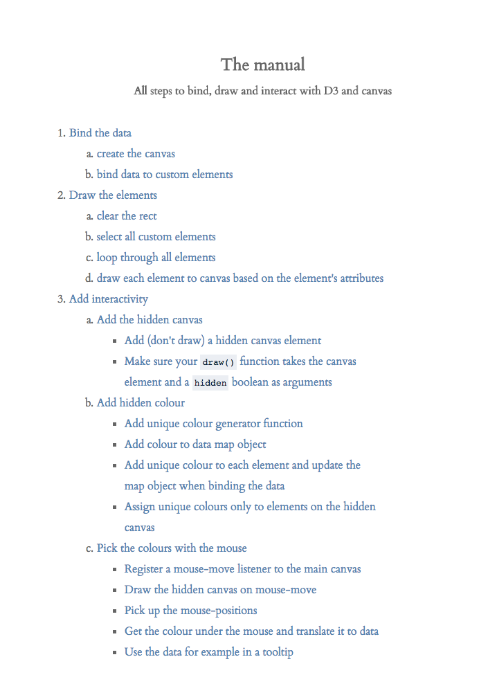
In that location's a footstep-by-footstep manual from scratch to interactive D3/canvas on my web log which allows internal page links. This style you tin meet the whole process in one view and click your way through it with ease:
…and here'southward the full code once more.
I hope you enjoyed reading this and please do say hello and/or …
lars verspohl www.datamake.io @lars_vers https://www.linkedin.com/in/larsverspohl
…is always grateful for a similar? or a follow he can return.
Learn to code for free. freeCodeCamp's open source curriculum has helped more than twoscore,000 people become jobs as developers. Get started
Source: https://www.freecodecamp.org/news/d3-and-canvas-in-3-steps-8505c8b27444/
0 Response to "drawing dots in 3d html5"
Post a Comment